
How People Think
Many people are genuinely surprised—sometimes deeply unsettled—when they learn that not everyone experiences thinking the same way they do. Some people have a continuous inner dialogue. Others think visually, spatially, emotionally, or intuitively, with little to no internal narration.
The surprise comes from a simple assumption:
we expect all thinking to resemble our own.
But in controlled sampling studies, participants reported inner speech in approximately only 20–25% of sampled moments, meaning most thinking occurred in other forms such as visual imagery, unsymbolized thinking, or sensory awareness (Heavey & Hurlburt, 2008).
In organizational settings, that assumption quietly shapes how leaders interpret silence, speed, confidence, and clarity. Over time, it influences who is trusted, who is promoted, and whose ideas gain traction. Understanding how thinking actually shows up—especially when it is quiet—has real consequences for leadership effectiveness.
Here are seven common misconceptions leaders hold about how people think and how it is impacting teams every day.
1. Thinking often occurs fully before it is verbalized
Many people complete their reasoning internally before speaking. Their thinking happens through pattern recognition, mental models, or felt coherence, and language is used afterward to communicate conclusions.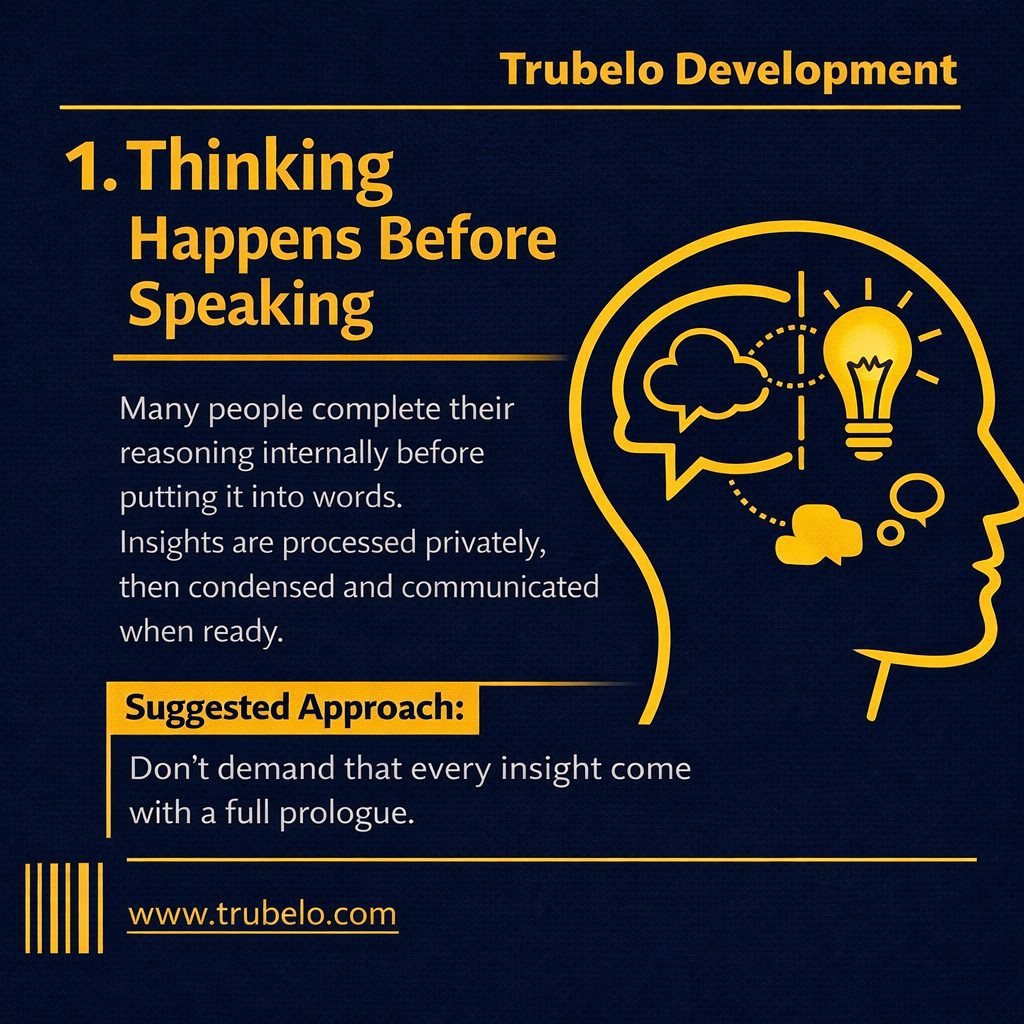
When these individuals speak, they tend to offer distilled answers rather than step-by-step narration. The reasoning exists—it simply isn’t externalized during formation.
This style is common among experienced professionals who have learned to compress complexity quickly.
Leadership implication:
Judging thinking quality by how much reasoning is spoken potentially undervalues well-formed judgment.
2. Silence is frequently an active cognitive state
Silence often indicates focused processing. For many thinkers, especially those who work tacitly, verbalizing too early interrupts cognition rather than advancing it.
These individuals tend to wait until an idea stabilizes before contributing. Their silence reflects attention, not absence.
Leadership implication:
Allowing silence creates space for insight to emerge, particularly from people who do not process verbally.
3. Verbalization is a thinking tool for some—and a reporting tool for others
Some people use language to discover what they think. Speaking helps them explore, refine, and test ideas in real time. Others think independently of language and use speech only to report conclusions.
Both approaches are cognitively valid. They simply rely on different internal mechanisms.
Leadership implication:
Meetings and, even more, leadership styles that privilege thinking-out-loud unintentionally favor one cognitive style over another.
4. Speed often reflects pattern recognition built through experience
Quick responses are frequently the result of repeated exposure to similar situations. Over time, the brain learns to recognize structures immediately, bypassing conscious deliberation.
This kind of thinking is efficient, not shallow. It is the same mechanism that allows experts to make accurate decisions rapidly in high-stakes environments.
Leadership implication:
Fast insight is often a marker of expertise and should be explored, not discounted.
5. Strategic insight commonly emerges as holistic recognition
Strategy rarely forms as a linear chain of reasoning. More often, it appears as a sense of alignment, direction, or coherence that becomes articulate only with time and reflection.
Leaders frequently recognize the right move before they can fully explain why it works.
Leadership implication:
Organizations that demand immediate verbal justification may suppress early strategic insight.
6. Cognitive behavior shifts under pressure
Stress changes how thinking manifests. Some people respond by narrating more—talking through scenarios, risks, and contingencies. Others narrow their focus, reduce communication, and concentrate on execution.
These shifts are adaptive responses, not indicators of capability.
Leadership implication:
Effective crisis leadership recognizes different stress responses without assigning value judgments to them.
7. Most thinking is inherently private
Cognition does not naturally leave an audit trail. Leaders observe outcomes, decisions, and behavior—not the internal processes that produced them.
Because thinking is invisible, managers often rely on proxies such as articulation, confidence, or speed. These signals are imperfect and culturally biased.
Leadership implication:
Strong leadership depends on interpretation and inquiry, not surveillance of thought processes.
The Leadership Opportunity
Understanding silence is not about accommodating preferences or lowering standards. It is about improving interpretive accuracy.
When leaders recognize that thinking takes multiple forms—and that language is only one of them—they reduce misreads, surface better ideas, and retain talent that might otherwise be overlooked. Work using the Varieties of Inner Speech Questionnaire demonstrates that inner speech varies not just in frequency, but in form—condensed, dialogic, visualized, or absent—suggesting there is no single “normal” way to think (McCarthy-Jones & Fernyhough, 2011).
The most effective leaders do not require thinking to sound a certain way. They learn how to listen for it—even when it is quiet.